.jpg)


What is the Commedia dell'arte ?
- SumMaSk

- May 7
- 5 min read
What are the origins of the Commedia dell'arte ?
Commedia dell'arte is a popular theatrical genre that emerged in Italy in the 16th century. It quickly achieved great success and became the most popular style of comic theatre, enjoyed by both the common people and the aristocracy. It is distinguished by improvised scenes and the use of masks. The first professional troupes appeared in 1550. This form of popular theatre features fixed characters, such as Harlequin, Punch, and Pantalone, recognizable by their masks, costumes, gestures, and mannerisms.
It was in the 16th and 17th centuries that the Commedia dell'arte enjoyed immense success in Italy, and then throughout Europe; this period is considered the golden age of the Commedia dell'arte. Troupes traveled from town to town, performing in public squares. Thanks to its universal language based on physicality, music, and extravagance, it captivated a wide audience. It influenced great authors such as Molière and Shakespeare.
Even today, the Commedia dell'arte continues to influence various art forms beyond the theater. Indeed, its legacy can also be found in mime, circus, and even cinema, particularly in silent comedies and in the physical acting of some contemporary performers.
Currently, the Commedia dell'arte is still taught in many drama schools, notably through mask work, voice work, and physical expression; but also through improvisation and the study of stock characters. She continues to inspire actors with her freedom of performance, her energy and her expressive richness.

What are the characteristics of the Commedia dell'arte ?
Commedia dell'arte is characterized by stereotypical, often masked characters who participate in farcical situations. These characters possess distinct traits, reflected in their masks, which represent archetypes of the society of the time.
Commedia dell'arte is a theatrical genre of improvisation in which the actors follow a script upon which they improvise.
The actors are specialists in improvisation and acrobatics, as the performances are punctuated by jumps, juggling, laughter, tears, and falls.
The plots are based primarily on universal themes understandable to all, such as deception or social and generational conflicts, thus allowing the audience to easily identify with the characters.
The ending is most often happy: the lovers marry, the servants profit, and the old men find another form of revenge.
Who are the charactes of the Commedia dell'arte ?
In the Commedia dell'arte there are three types of characters: i vecchi (the masters or old men), i servi (the servants or i zanni) and finally other characters who belong neither to the first nor the second category.
I vecchi
First, there is Pantalone (Pantalons). This character represents the archetype of the rich, miserly old man with a penchant for beautiful young women. This greedy old merchant is always dressed in luxurious, worn clothes. He is from Venice.
Pantalone's mask is characterized by a long, hooked nose, furrowed brows, and stern features.

Among the old men, we also find il Dottore (the Doctor). He is a medical doctor from Bologna who seems to know everything, speaking Latin without truly understanding it. He may also be a professor, magistrate, or notary; in any case, he holds a position of power linked to knowledge. Ironically, this character is satirized by his lack of knowledge despite his learned appearance. He is dressed in a black robe. His mask consists of a large, deformed, dark nose (or one marked with a black spot).

These first two characters exist in many variations (Pantalone Magnifico, Pantalone dei bisognosi, Dottore Balanzone, Dottore Graziani...)
I servi
To begin, we'll talk about Zanni (it's worth noting that Zanni is the term used to refer to all servants in the Commedia dell'Arte). This character is therefore a Zanni Zanni. He is characterized by his foolishness, his stupidity, and his impulsive nature. His mask features a very long nose.

Another well-known servant is Arlecchino (Harlequin), who is from Bergamo but lives in Venice. His character is reminiscent of Zanni; he acts simply, both in his gestures and his thoughts, but in a more naive than impulsive manner. However, he also has a brilliant and resourceful side, as he always has to find a solution to the catastrophes he faces, or even causes himself. He is as clumsy as he is agile (hence the term "mask" and "counter-mask"). He thinks primarily of his own interests. His clothing is colorful; he is free and authentic. His mask, on the other hand, represents a very specific social character: that of an emigrant, a beggar, and a highly anarchic individual. His mask has hollow cheeks with prominent cheekbones, a slightly upturned nose, and arched eyebrows.

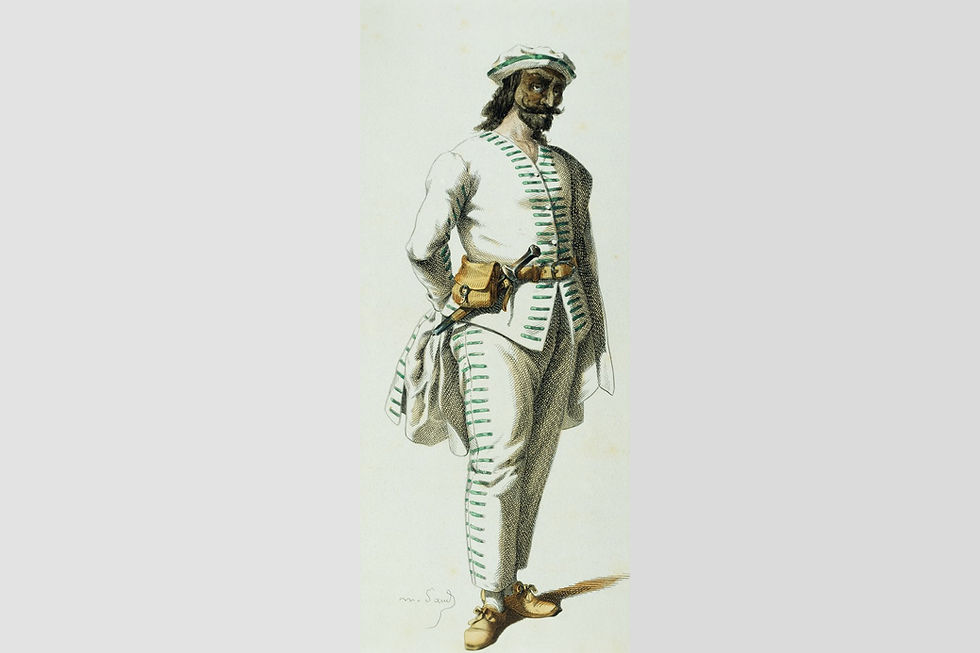
Another essential servant is Brighella, originally from Bergamo. He shares some traits with Arlecchino in his cunning and laziness. One could even say that Brighella is a second Arlecchino, a slightly older, plumper Arlecchino who earns a better living but still remembers the hardships of his past. He is loyal, but also very scheming, even quarrelsome.

Pulcinella (Polichinelle) originated in Naples. His mask is recognizable by the wart on his prominent nose and the deep wrinkles visible on his forehead. The character of Pulcinella represents the Neapolitan duality between life and death. He is often dressed in white with a black mask.

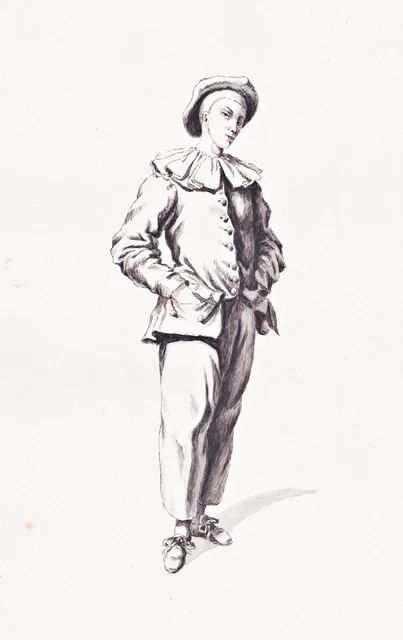
Pedrolino, also dressed in white, is a naive but honest valet. He is easily distracted and lets his lightheartedness lead him to adopt a unique, new perspective on the world. His mask is composed of round cheeks and a turned-up nose.
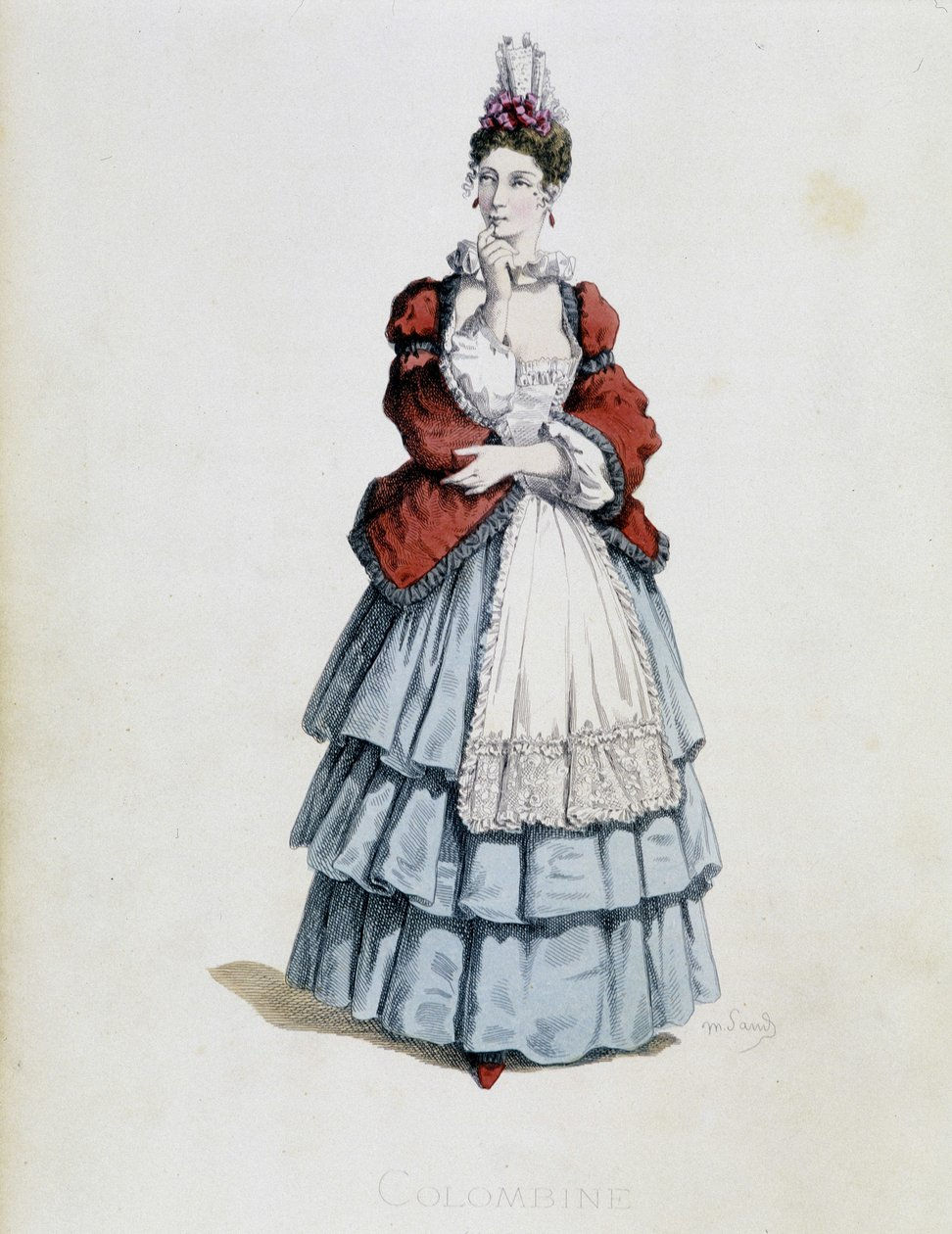
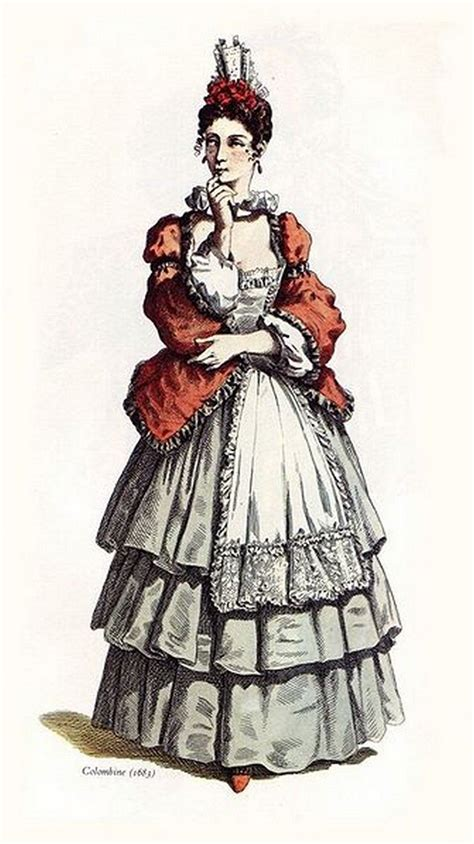
Finally, there is Colombina, a young servant girl who presents herself as a mischievous person who knows how to use her charms to get what she wants. Historically, the character of Colombina is not depicted wearing masks but generally wears simple women's clothing.
The other caracthers
There is Tartaglia, originally from the Naples region. He represents a clumsy, stuttering Spanish civil servant. He wears large glasses and faded green clothes. He feels out of place everywhere, as the aristocracy disregards him and the common people dislike him because of his civil servant status. His character is sometimes harsh and tyrannical when he loses his temper, and sometimes timid and repressed. His mask features sunken eyes and a triangular nose.

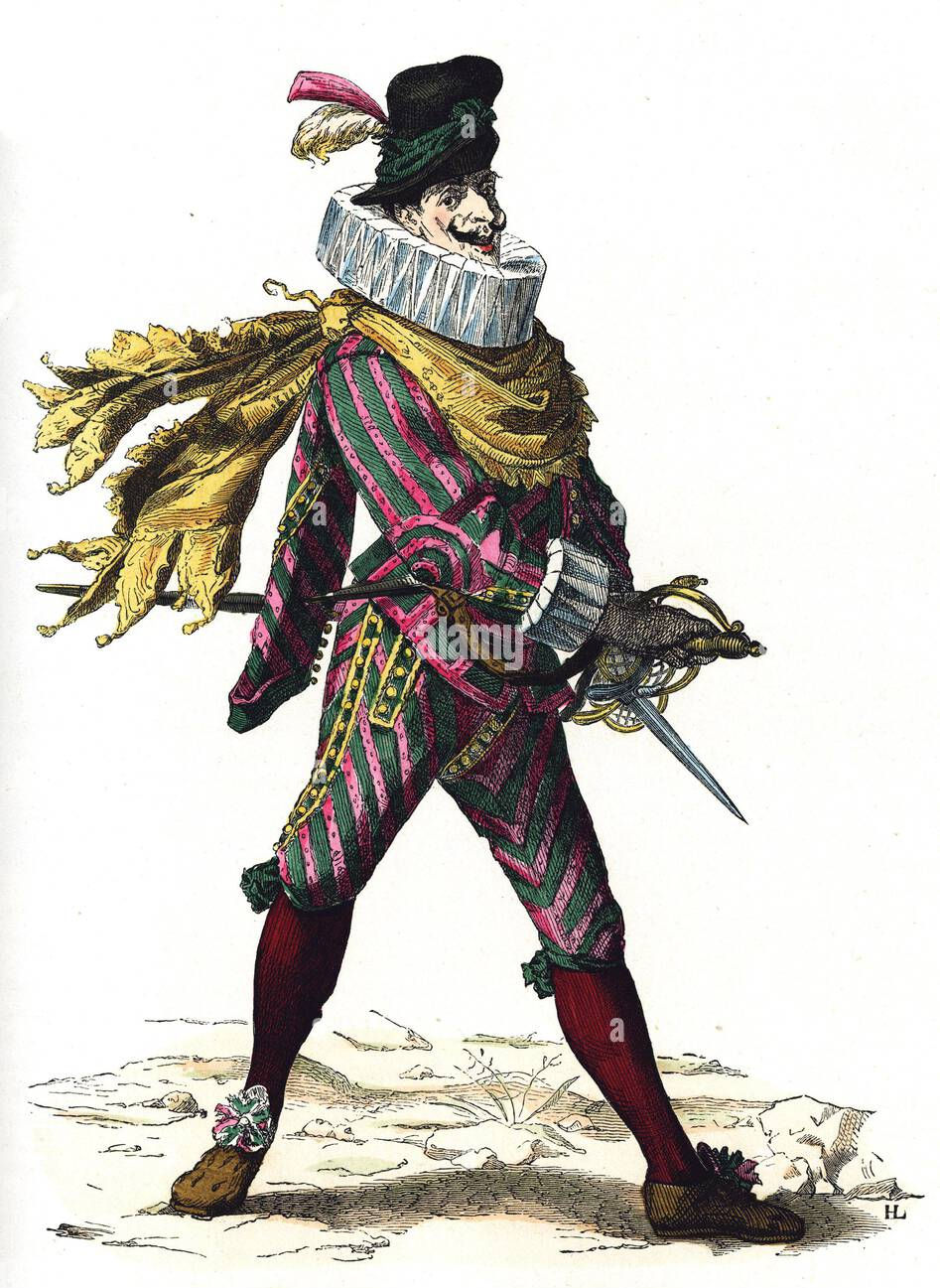
Il Capitano (The Captain) is also of Neapolitan origin; he is a Spanish captain based in Naples who likes to boast and braggart to hide his cowardice. Il Capitano criticizes the military heroism of the time. His mask has two triangular shapes: his nose jutting forward and a triangular symbol pointing backward on his temple. This character is halfway between fear (triangular shape pointing backward) and aggression (triangular shape pointing forward).

Finally, there is Cyrano, who is also a captain because his mask is composed of the same triangular shapes. However, Cyrano has a more lighthearted and poetic, boastful character, which is reflected in his mask, giving it a gentler appearance than that of the captain.