.jpg)


Who is Harlequin ?
- SumMaSk

- 2 days ago
- 2 min read
Harlequin (Arlecchino) is an iconic character of the Commedia dell'arte, often associated with the Zanni family (the servants), but he stands out for his expressive richness and ambivalent nature. A prankster, agile, cunning, and profoundly free-spirited, Harlequin is a character always in motion, both mischievous and elusive. But he is also always hungry, because he is poor, and thus always looking out for his own interests. He frequently addresses the audience, uses his body to express himself, juggles situations as easily as objects, and slithers into intrigues like a cat or a monkey: clever, instinctive, and never where you expect him to be.
However, like all masks, his character is often contradictory: he can also be very clumsy, naive, and cause catastrophes that he then resolves in the blink of an eye.

What are the origins of Harlequin ?
Harlequin's roots are many. He is said to be inspired by the medieval French demon "Hellequin," leader of a troupe of black-masked figures who terrorized towns during the Middle Ages. But in the Commedia dell'arte, Harlequin emerges around the mid-16th century, described as originating from Bergamo—though he is not its official mask. He represents a poor mountain dweller, an emigrant to Venice, discovering the city with a mixture of fascination, envy, and mischief. Harlequin is thus a mask of exile and resourcefulness, both foreign and familiar, free and marginal. His silhouette is that of a "merry devil," with a supple body and a feline mask.
What are the characteristics of Harlequin ?
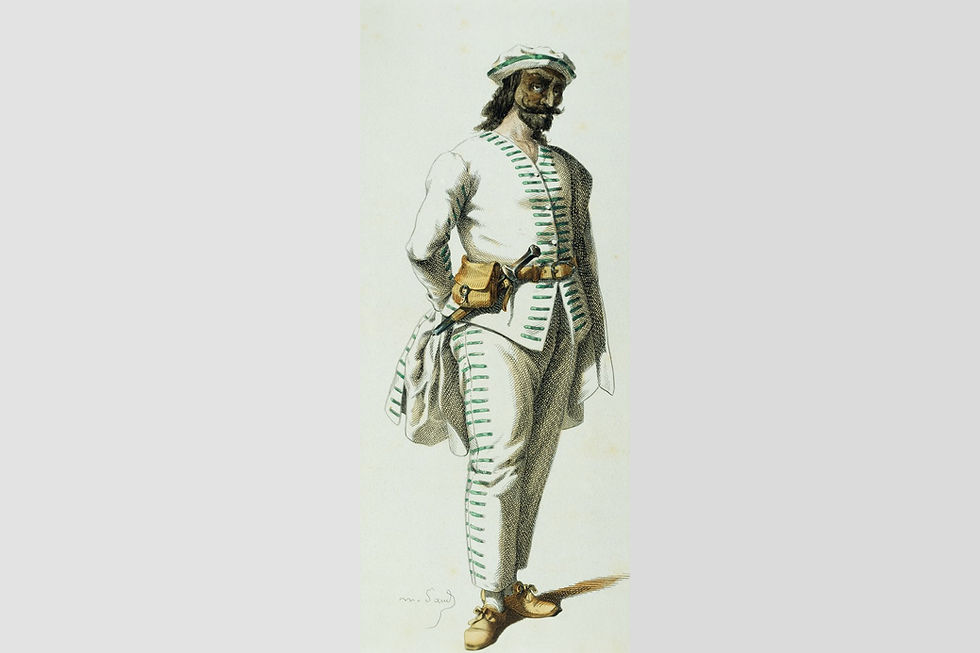
Harlequin wears a costume made of colorful scraps of fabric, originally patched rags, symbols of his poverty and whimsy. His flat, black mask, often featuring a bump on the forehead (an ancient vestige of a demonic horn), gives him a feline or simian appearance, depending on the interpretation. Harlequin jumps, climbs, juggles, mimics, slips, disappears, reappears… always in search of food or a good trick to play. He has a shifty but laughing gaze, a lively voice, and embodies all the vitality, cunning, and survival instinct of someone without considerable means.